



In search of an oasis
In search of an oasis

NAVER Cloud | Service & Business | Dave Geunchang Jang
Saudi Arabia – the new land that NAVER is headed to. In this faraway land in the Middle East, NAVER’s technologies are taking root.
With the digital twin bringing the physical world to the virtual world, complete with sophisticated robotics and AI technologies, NAVER has successfully won the heart of the massive market that is Saudi Arabia.
Dave Geunchang Jang is in his 18th year as a business developer and is currently leading TEAM NAVER’s first-ever attempt to expand its footprint to the Middle East.
Business development in nature is all about dealing with unexpected variables, but doing business in Saudi Arabia, where the culture and the way of work are both unfamiliar, was a new challenge even to a seasoned veteran like Dave.
In challenging times, Dave would repeatedly tell himself, “Fine, then.”
It is a testament to his determination that if something does not work, he will find another way.
Challenges may be inevitable to someone like Dave, who is unafraid to cross the 50-degree desert to discover unprecedented business opportunities with Korean technologies, competing against global tech giants along the way.

Tell us about your work.
I am in charge of discovering new markets that require services and technologies developed by NAVER Cloud and TEAM NAVER, and establishing business plans that fulfill their needs. Recently my work has expanded beyond Korea to establish and develop global businesses, especially in Saudi Arabia.
We were told that you were suddenly tasked with leading the Saudi business.
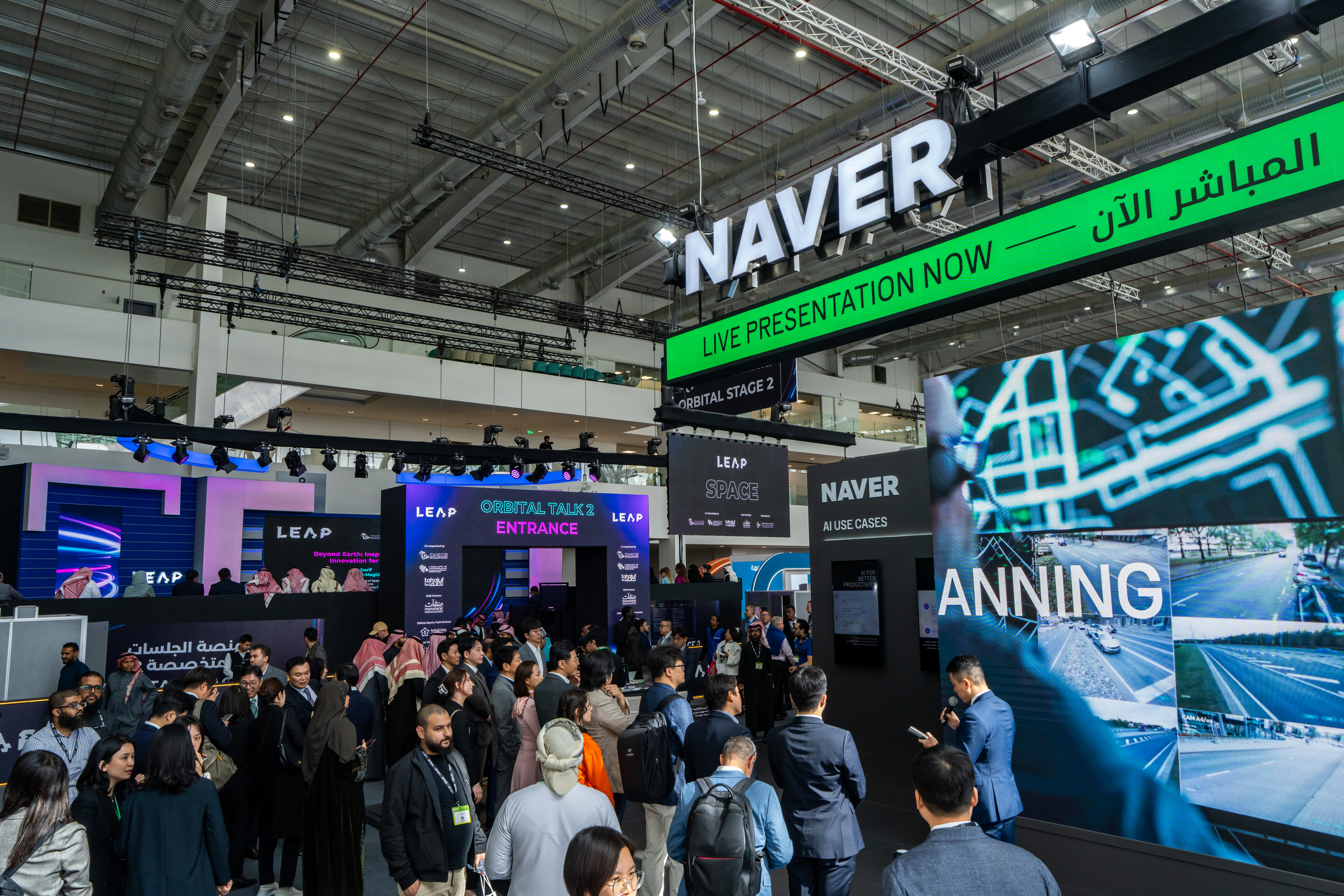
In 2022, the Korean Minister of Land, Infrastructure and Transport initiated the project “One Team Korea” to support Korean companies trying to land business opportunities associated with NEOM City* in Saudi Arabia, which NAVER joined. Back then, NAVER showcased our “digital twin” technology that creates a duplicate of the actual data onto the virtual screen, and ran simulations for flood prevention. We were surprised to find out that in Saudi Arabia, where the majority of the land mass consists of desert, there is an area that is damaged by flood every year – a city called “Jeddah” suffers from heavy rain, which makes the entire city operations stop and causes massive casualties. NAVER’s technology was a perfect fit for this pain point that Saudi Arabia was hoping to address. This coincidence became an opportunity for the Saudi Ministry of Municipal and Rural Affairs (MOMAH) to take a great interest in NAVER, and that was when I put together a team and began traveling to Saudi Arabia, proposing different ideas that would meet our client’s needs.
*NEOM City : A project to build an eco-friendly smart city 44 times the size of Seoul in northwestern Saudi Arabia
We were told that you are collaborating not just on digital twin, but also on other domains.
Starting with digital twin, we are mainly working with four major clients to expand our business. With MOMAH, we are working on a map service for all citizens of Saudi Arabia. We’re also working on robots and a platform for the NEOM City project using NAVER LABS’ robotics technology. In addition, we’re preparing a collaborative application for enterprise based on NAVER WORKS with Aramco*, and a sovereign AI business to develop an Arabic LLM with Saudi Data & AI Authority (SDAIA).
Our project with MOMAH is one of the largest global projects that NAVER has ever won. I don’t think my work is only about selling NAVER’s technologies. With NAVER stepping foot into the new market that is the Middle East, other tech startups and public entities in Korea will also be able to leverage that as they enter the global market. In fact, we are working on our digital twin project with LX and K-water. As much as I wish our business to thrive, I am also working on this project with a sense of responsibility.
*Aramco : Saudi Arabia’s state-owned petroleum and natural gas company
You said there were times when business seemed to be cruising along, only to face obstacles the next moment.
There were obstacles and difficulties as we prepared for the business, but our true north had always been signing the Phase 1 Agreement, for which we had so closely worked with the Saudi government and partners. But there was a moment when the project suddenly turned into an open tender, meaning that we had to redo the year’s worth of work that we had already put into the proposal all over again. I was frustrated and worried that we would have to survive the competition against global tech giants, but we went through the preparation again, telling ourselves that we must “make it happen, whatever it takes.” We once went on a business trip to a city named Hofuf in Saudi Arabia to present our proposal. The temperature was hitting 50 degrees Celsius, and it felt like there was a hairdryer constantly blowing hot air straight into my face. We had to get on a train that went across the scorching hot desert of 50 degrees Celsius for two to three hours, and I remember how everyone immediately got in a group hug and exclaimed in pure joy when we were told that MOMAH wanted to sign the deal with NAVER. I can now look back at everything with a smile on my face, but we were all so panicked back then. Thankfully, we were able to sign the agreement and are currently delivering the business outcome without further issues.
What was the core strength of NAVER that enabled the company to land the deal successfully?
Doing global business involves competing against well-renowned global companies that everyone knows, and there are times when I feel like things could be better. Sometimes it is a wonder that we are able to stay in this competition with less than ten thousand people on board, while global companies would have several times more employees than us. But I think that actually led to NAVER’s competitive edge. Global companies are bigger in size and often have their own standards, which means they would not go ahead with a project at all if they decide that it will not be profitable. However, NAVER was able to respond to clients in an agile manner, and we could offer customization of our technologies catering to our clients’ requirements.
What was especially more remarkable was that the Saudi project was truly the epitome of what “TEAM NAVER” can do. I believe none of this would have been possible if it was only dependent on NAVER Cloud’s technology alone. This is something we all worked together as a team – NAVER Cloud’s technology and server infrastructure, NAVER LABS’ digital twin technology, and NAVER’s Government Business Strategy organization, with their extensive support in B2B and B2G businesses, have all come together to make it happen. There are lots of global companies out there that have expertise in a single technology, but we are probably the only company that provides an all-in-one package for technologies that fit clients’ needs. I would say this is a competitive advantage that only NAVER can provide.
What does it mean to be good at your job?
Simply put, being good at your job means you perform. It is more so for my line of work, which is business development. Your performance has to contribute to the company, and how you define performance must be aligned well with the company’s standards. What is just as important is that your performance leads to your motivation and drive, since that will allow you to complete this long marathon without being worn out. I believe NAVER is a company that makes sure that an individual’s performance makes an impact on themselves, and that it leads to their own motivation. Each individual is given a lot of authority – that’s also what surprised me the most after I joined NAVER Cloud. There is no one that tells others what to do. Rather, each individual takes responsibility for the work they choose to do. That is the same principle that I apply to myself as I work, and I also try to encourage my teammates to do the same. And I believe those who are able to define the meaning of their work are the ones who are good at their job. I see so many of them here in NAVER.
Lastly, you are the one who helped NAVER dream new dreams. Tell us more about what kinds of dreams that you have for yourself.
I have always dreamed of setting foot in the global market with Korea’s IT technologies. It would make me really proud as a Korean of course, but I also think it would add value to the rest of the world when Korean technology is added to places that need it, places that don’t have it yet. In that sense, my dream is to pitch NAVER’s well-made technologies to the entire rest of the world. It would be great if I could play a part in the dream that NAVER is trying to achieve. I do feel a bit pressured since so many colleagues and people around me have been paying attention to our Saudi project, which is just at the starting point. Although many people have been complimenting me on the work I’ve done for the past year or two, I find myself wondering, “So what should I do next year, then?”. Our team will have a workshop next week under the theme, “How to Survive.” We have no idea what kinds of resolutions we will draw yet, but we will continue to challenge ourselves no matter what. If it doesn’t work? Fine, then. We will find a way.
