




Keeping curiosity alive
Keeping curiosity alive

NAVER | Service & Business | Lim Jung-hwa
In August 2023, NAVER unveiled its hyper-scale AI, HyperCLOVA X and the conversational AI, CLOVA X, signaling a transformation in everyday life and business. Lim Jung-hwa, a veteran service planner with 20 years of experience, has witnessed and contributed to such evolution from the first AI-powered product, the CLOVA Smart Speaker, to today’s HyperCLOVA X.
When asked about how she envisions AI’s role in people’s lives, Lim offers an unexpected answer: “curiosity.” This is quite different from the common AI narrative that the technology assists in achieving superhuman productivity and efficiency. A human desire to know and understand is behind the questions we ask AI. Lim defines her work as encapsulating technology that wins users’ hearts, creating something that keeps curiosity alive.

What kind of service is CLOVA X?
Let me first explain HyperCLOVA X, the underlying technology behind CLOVA X. It is a large-scale AI technology that learns from vast amounts of information, able to think and reason like a human. It’s the third LLM in the world, developed using NAVER’s own technology. The company leverages this HyperCLOVA X in various services, including CLOVA X, our conversational AI service, and CUE:, a search assistance.
Among the line-up, my team was in charge of CLOVA X planning, a service that allows you to get information and assistance by chatting with AI. It makes it much easier to find information, which previously required direct searching, and can even write essays on topics of your choice. Numerous conversational AI services are out there, but what makes CLOVA X special is its unrivaled understanding of the Korean language and Korean users. Its exceptional language comprehension capabilities enable the model to be integrated with other NAVER services, and analyze and edit documents and images. The journey leading up to the launch was a race against time. I was excited during the preparation and felt relieved when the service was successfully unveiled. The reactions that resonated with me were “Here comes a good Korean AI model finally,” “NAVER put its soul in it,” and “NAVER gritted its teeth.”
Tell us about your journey at NAVER.
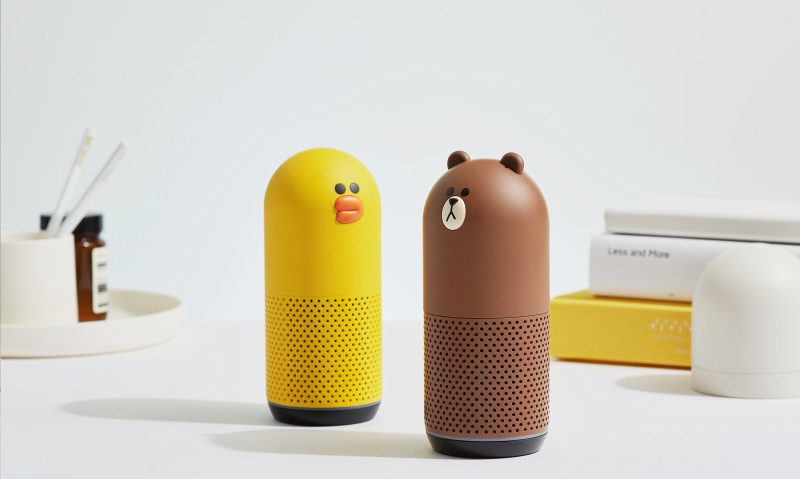
I started my career as a UX researcher. I joined NAVER in 2016 after hearing the news that the company established a department dedicated to designing services using AI. Since then, I have been working across all areas where NAVER’s AI is involved. My organization’s first mission was to make a smart speaker. I remember that, at the time, AI was very new, so we tried to implement the technology by integrating it into devices like speakers and clocks. This led to the creation of CLOVA Speaker, CLOVA Clock, and CLOVA Lamp. After embedding AI into daily life with these products, we began to think about services that could provide value to users without the need for devices. It was because what AI can do goes far beyond just telling the time or weather. The major services we developed at the time were CLOVA Note and CLOVA Dubbing, which were designed to reduce unnecessary efforts and enhance user productivity.
Since then, with the development of HyperCLOVA X, NAVER’s first large-scale language model, we have been working on various services using the technology. My goal now is to help services such as CLOVA X take root. Furthermore, you will see other products coming soon as NAVER is preparing services like PROJECT CONNECT X, a B2B service aimed to boost employees’ productivity.
Any project you feel particularly proud of?
Designing services using HyperCLOVA X is one part of my job and the other is embedding AI technology into NAVER’s services. I’m interested in how our technology translates into meaningful services for users. In this regard, I feel really great about the collaboration with NAVER Smart Store. What Smart Store sellers want is to lock in customers who visit their stores. To this end, it is essential to effectively display items that draw users’ attraction. Our CLOVA MD recommends products within the store that are most likely to interest users based on their tastes and preferences. The technology behind CLOVA MD is now used in NAVER Fashion Town and advertising for personalized recommendations.
For sellers, customer service seemed as challenging as marketing. NAVER created a light CS chatbot for small stores that cannot afford dedicated CS staff. We provide them with FAQ sets from other stores selling similar products, and the sellers can just fill out their own answers. Then, the chatbot will respond to customers based on these inputs.
Our Smart Store Seller Management team received feedback that asked the company to keep such a great product. It was a moment of pride, knowing that our technology is truly helping these sellers.
When was your most memorable moment at work?
It was about five to six years ago when I was making CLOVA Smart Speaker. Unlike now, back then, we often worked late into the night leading up to a product roll-out. One day, I complained to a teammate, asking “Why are we working so hard?” The answer was “I find this so fun. Isn’t it fascinating how the speaker can give such responses?” That moment was an eye-opener for me. The colleague was much more senior than me, and we were all exhausted at the time. However, those words made me realize that I was having an experience that I wouldn’t have had if I were not at NAVER. I still feel the same way today. I am excited about the AI services that only NAVER can showcase, expecting them to bring about changes in people’s lives.
What does it mean to be good at your job?
When I first started working, I was preoccupied with identifying the problem at hand and figuring out how to solve it nicely, which seemed impressive. But as time passed by, I realized that while coming up with brilliant ideas is a valuable talent, implementing them requires more than talent. Especially in service planning, cool concepts and ideas can come and go, but implementation is the hard part. It is easy to say “I want to see a more friendly AI.” But not many people can answer, “Then, how can we make AI speak more gently?” I believe that those who tirelessly try and fail to answer such questions are the ones who excel at their jobs.
People often think of those who propose brilliant ideas as good at their jobs. On the other hand, those quiet implementers do not get as much spotlight. However, at NAVER, I have seen more people who put things into action. When designing AI, trying something does not hurt the technology. Those who keep trying despite failing and closely look into their failures are the ones who bring something new to the world.
What do you want AI to be like for humans?
I have a 10-year-old son. He’s now a big boy, but still is very curious about the world. He asks me things that I’ve never even thought of – like why the sky is blue and why clouds only float in the sky. It is hard to answer these questions. Yet, children seem to grow by finding their own answers. Adults also have many such moments, but at some point, we stop asking questions. I want AI to help adults stay curious because I believe that even as grownups, we still have curiosity and a passion for learning.
The search process familiar to us involves people entering keywords and sifting through the given information to find answers. We may see the information edited by algorithms, or miss key information sometimes. When failing to find what you are looking for, you might give up on the search itself. However, conversational AI will help you continuously ask questions in your own words and explore answers. I would love to create a product that allows people to delve into questions they might otherwise overlook and keep their curiosity alive.
