




CEO Seok Sang-ok of NAVER LABS presents on “New Connections: Spatial AI, Digital Twin, Cloud, and Robotics for Future Cities” at WHC 2025
CEO Seok Sang-ok of NAVER LABS presents on “New Connections: Spatial AI, Digital Twin, Cloud, and Robotics for Future Cities” at WHC 2025
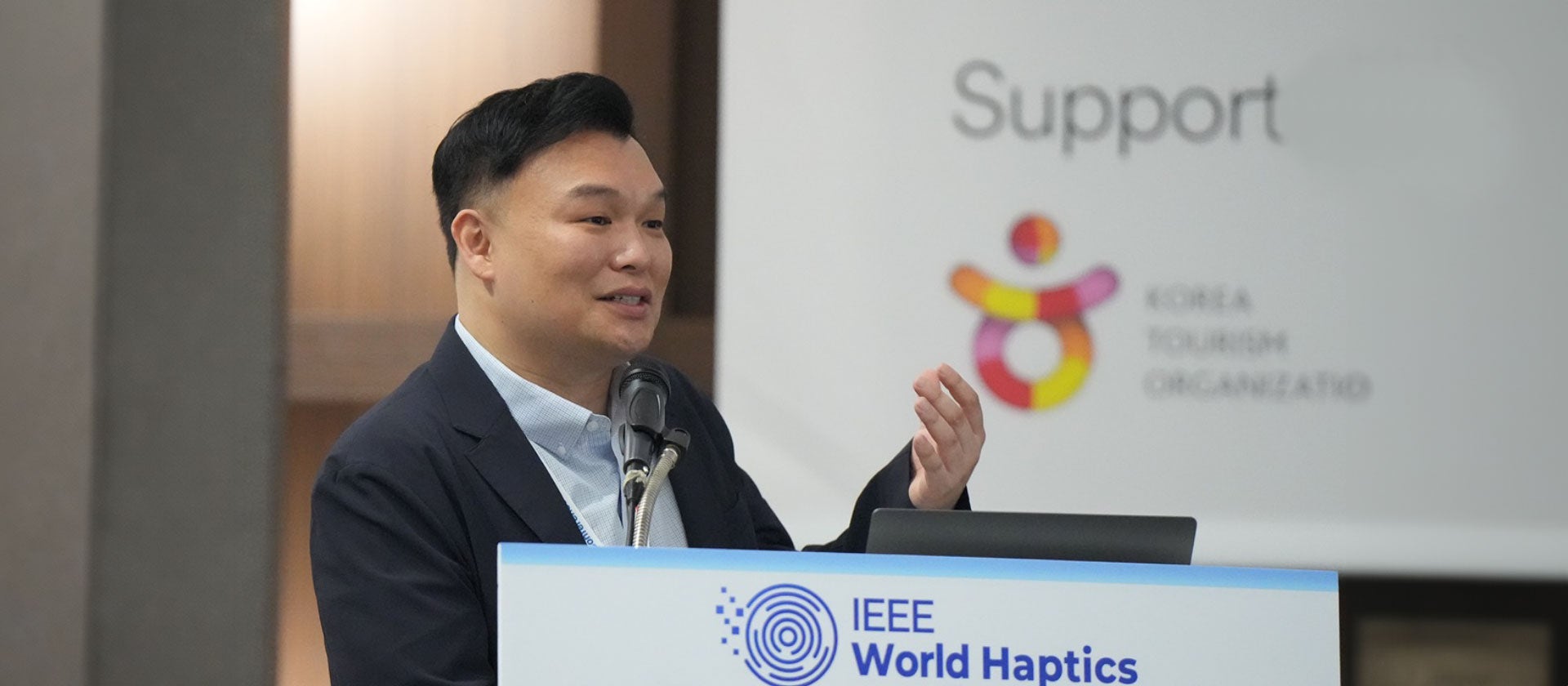
On July 9, 2025, CEO Seok Sang-ok of NAVER LABS participated as a plenary speaker in the IEEE World Haptics Conference 2025. In his talk, titled “New Connections: Spatial AI, Digital Twin, Cloud, and Robotics for Future Cities,” Dr. Seok shared the core technologies developed by NAVER LABS and the road ahead for the company, as it prepares for robotics services at a city scale. Below are some of the excerpts summarizing the key points from his session.
Broadening horizons, from buildings to cities
In future cities, hundreds of thousands of robots will be organically connected with humans to be an integral part of our everyday spaces. To prepare for what is ahead of us, NAVER has built an infrastructure that will function as the brain and eyes of robots, and is fostering an environment where anyone can create robotics services.
1784 is NAVER’s second headquarters that opened in 2022, designed to be the world’s first robot-friendly building to test the company’s vision of “a world where humans and robots coexist in harmony.” Here in 1784, NAVER is managing and orchestrating approximately 100 robots as we try out various robotics services. The data and know-how we acquired in 1784 became the basis for applying our robotics systems to GAK Sejong, Asia’s largest hyperscale data center, and we are currently widening the scope of our application to system operations at a city level.
NAVER’s technologies – foundation for future cities
NAVER has been developing technologies necessary for robots to freely move within cities, recognize their surroundings, and interact with humans. First of all, our “digital twin” technology, which replicates urban spaces into a digital environment in great detail, has been applied to major cities in Saudi Arabia to contribute toward creating smart cities. On top of this, when you add our spatial intelligence technology that enables robots to identify where they are using visual input through cameras, that allows for autonomous driving, making it possible for robots to freely roam around different parts of the city.
As our robots become capable of more tasks and the number of robots increases, it becomes more difficult to manage each and every one of them individually. That is why NAVER developed “ARC,” a cloud-enabled system that can manage all robots at once. The safety and efficiency of this system have already been validated, as this system has already been implemented in 1784 to operate over 100 robots all at once. Not only that, we have also unveiled “ARC mind,” the world’s first web OS for robotics that enables all developers across the globe to easily develop robotics services. Without complex programming knowledge, this OS enables services like ordering and payment to be connected to robots with web technology alone, fostering an environment that welcomes more and more people to develop robotics services.
Going beyond Korea and onward to global smart cities
NAVER’s robotics technologies are going global beyond borders, even as we speak. We are working on a digital twin platform that replicates major cities of Saudi Arabia in a digital world to address various problems in urban settings, and a smart building project in Tokyo is currently underway with the NTT group, a major telecommunications corporation in Japan. More recently, our technical collaboration has expanded toward creating a smart city in the heart of the capital of Saudi Arabia. NAVER will continue to collaborate with a wide range of global partners to implement smart cities in different regions across the globe ●
