





DUSt3R: A New Era in 3D Reconstruction
DUSt3R: A New Era in 3D Reconstruction
What if you could take a a single photo and transform it into a 3D space in just a few seconds? Meet DUSt3R, the spatial AI technology that has made this a reality.
A Game-Changing Innovation in 3D Reconstruction
DUSt3R is a breakthrough 3D reconstruction method developed by NAVER LABS Europe. Traditional 3D reconstruction techniques were complex—requiring multiple images, camera information and sequential processing steps—and often resulted in inaccurate or incomplete outputs. DUSt3R, however, generates a 3D model output with depth information in a single step from which geometric structure and even camera information can be extracted.
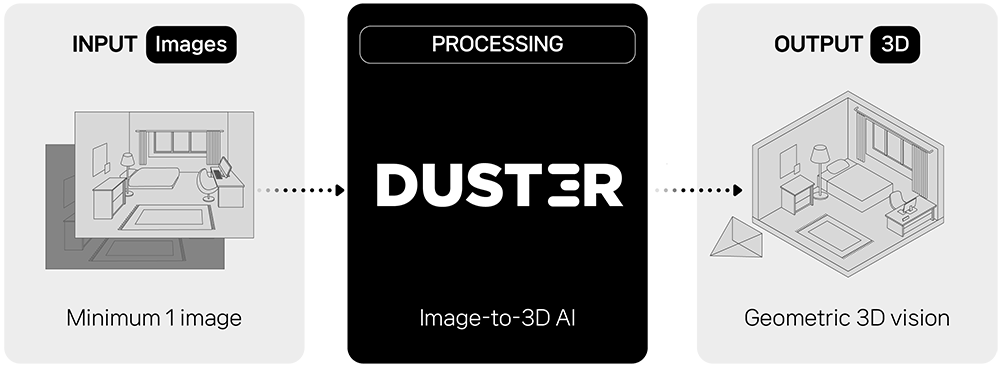
The simple DUSt3R 3D reconstruction process
By combining simplicity with powerful capabilities, this technology shattered the limitations of conventional methods in a single swoop.
"Is This Really Possible?"
Researcher Jérome Revaud who led the development of this groundbreaking work at NAVER LABS Europe explains that the initial reaction to DUSt3R in the community was one of pure disbelief and the NAVER LABS researchers had to prove that it worked.
As soon as they were witness to DUSt3R reconstructing a flawless 3D space from just one or two images in mere seconds, they couldn't hide their amazement. The technology quickly became a huge attraction at major AI conferences including world-renowned CVPR, where DUSt3R presentations sparked a flood of interest and inquiries. It wasn’t long before industry, academia and the media had all turned their attention to DUSt3R.
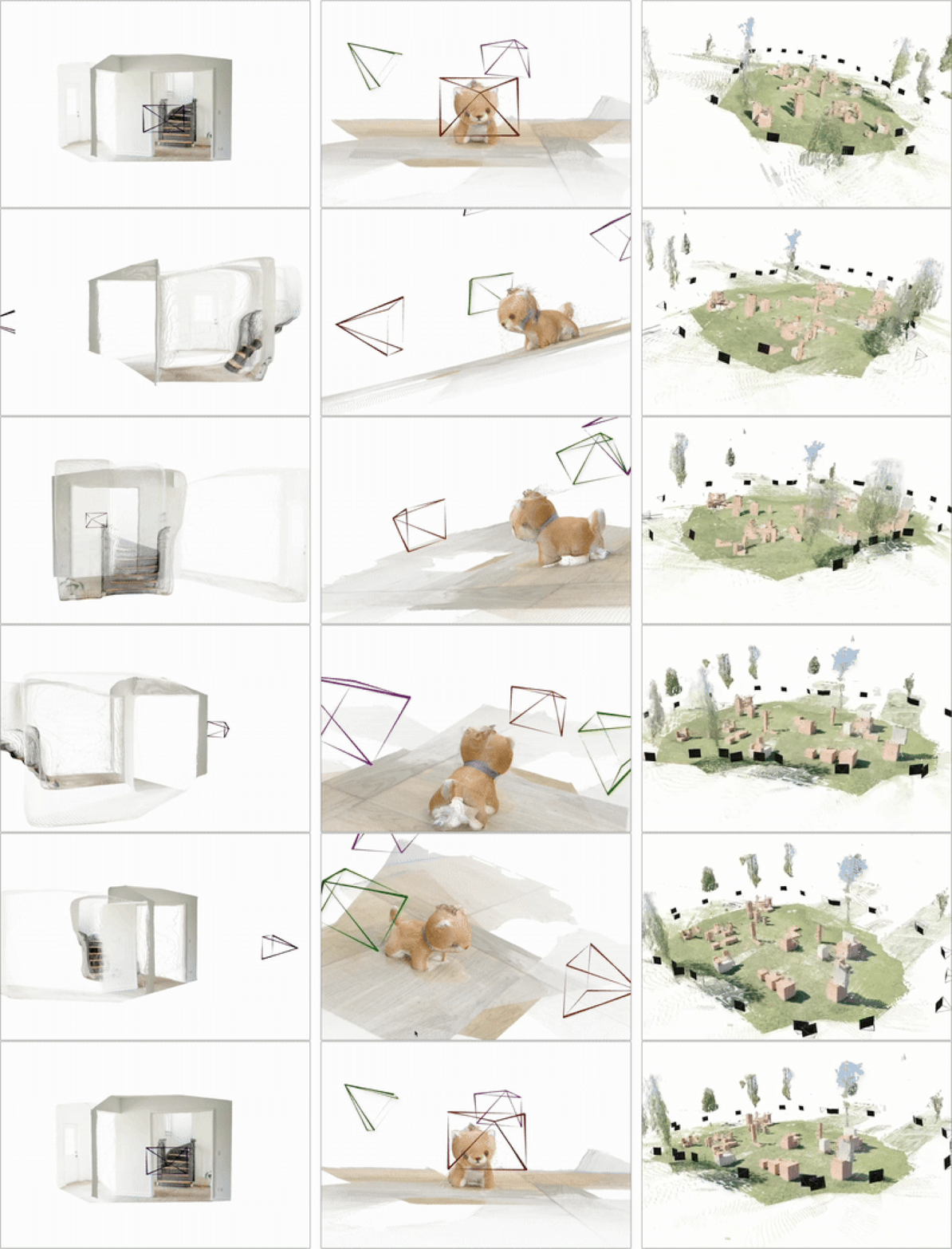
Examples of 3D reconstructed images using DUSt3R
Breaking Records, Driving Change
The impact of DUSt3R has been nothing short of remarkable.
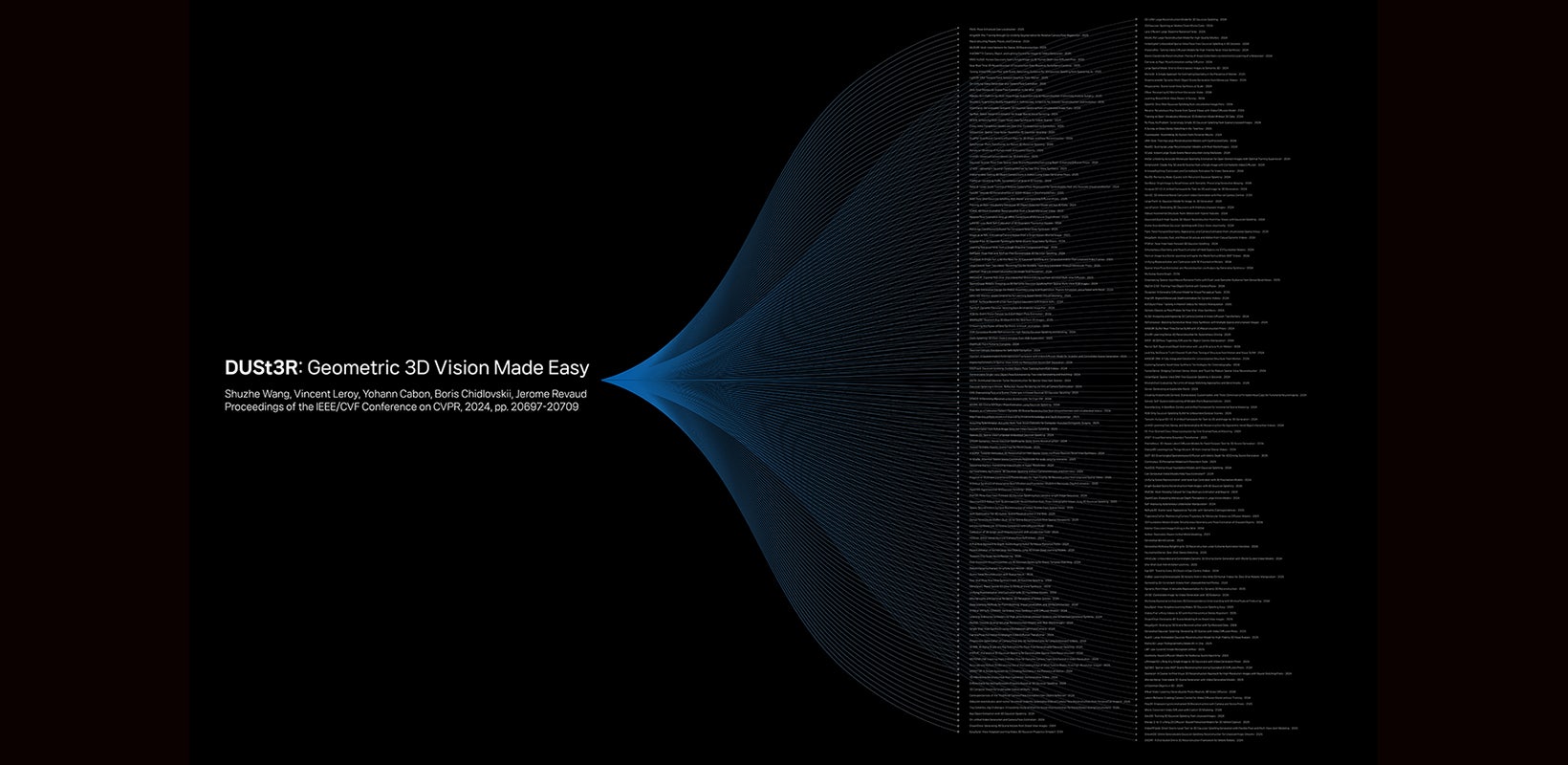
In less than a year since its release, the research paper ‘DUSt3R: Geometric 3D Vision Made Easy’ has been cited over 200 times. Considering that only a very small fraction of computer science papers only ever surpass 100 citations, this rapid growth signifies that DUSt3R is more than just academic success; it’s a paradigm shift in technology.
.jpg)
The DUSt3R paper has been cited over 200 times
DUSt3R’s influence has quickly spread among AI 3D vision researchers as each new model has had significant impact on both academia and the industry as a whole. Moreover, its open-source model has inspired derivative research at leading AI labs worldwide, including Meta Research, Google DeepMind and NVIDIA Research.
In an incredibly short time, DUSt3R has become the epicenter of 3D vision research, setting unprecedented milestones and driving continuous innovation. This achievement is the result of groundbreaking ideas and the relentless passion of the scientists who brought them to life.
For deeper insight, continue reading the Q&A interview with Jérome Revaud.
_______
Interview with DUSt3R Researcher Jérome Revaud
Q. Could you briefly introduce yourself?
I lead 3D vision research at NAVER LABS Europe. My recent work focuses on image matching and 3D reconstruction.
Q. What were the limitations of traditional 3D reconstruction methods?
They were highly complex. Converting 2D images into 3D required multiple photos, separate predictions of depth maps and camera poses, and a sequential process to align them. This approach wasn’t very efficient and often lacked accuracy.
Q. What was your approach to solving this problem?
We introduced a new concept called the "pointmap." Graphic designers may be familiar with how traditional images are represented using RGB (red, green, and blue) values. Instead of RGB, the pointmap encodes each pixel as x, y, and z coordinates, providing a new output format. It basically transforms a 2D image into a 3D point cloud structure and this single step output structure integrates spatial elements such as depth, geometric information and even camera parameters. Initially, many researchers were skeptical, thinking it was impossible, but through experiments, we quickly proved its feasibility.
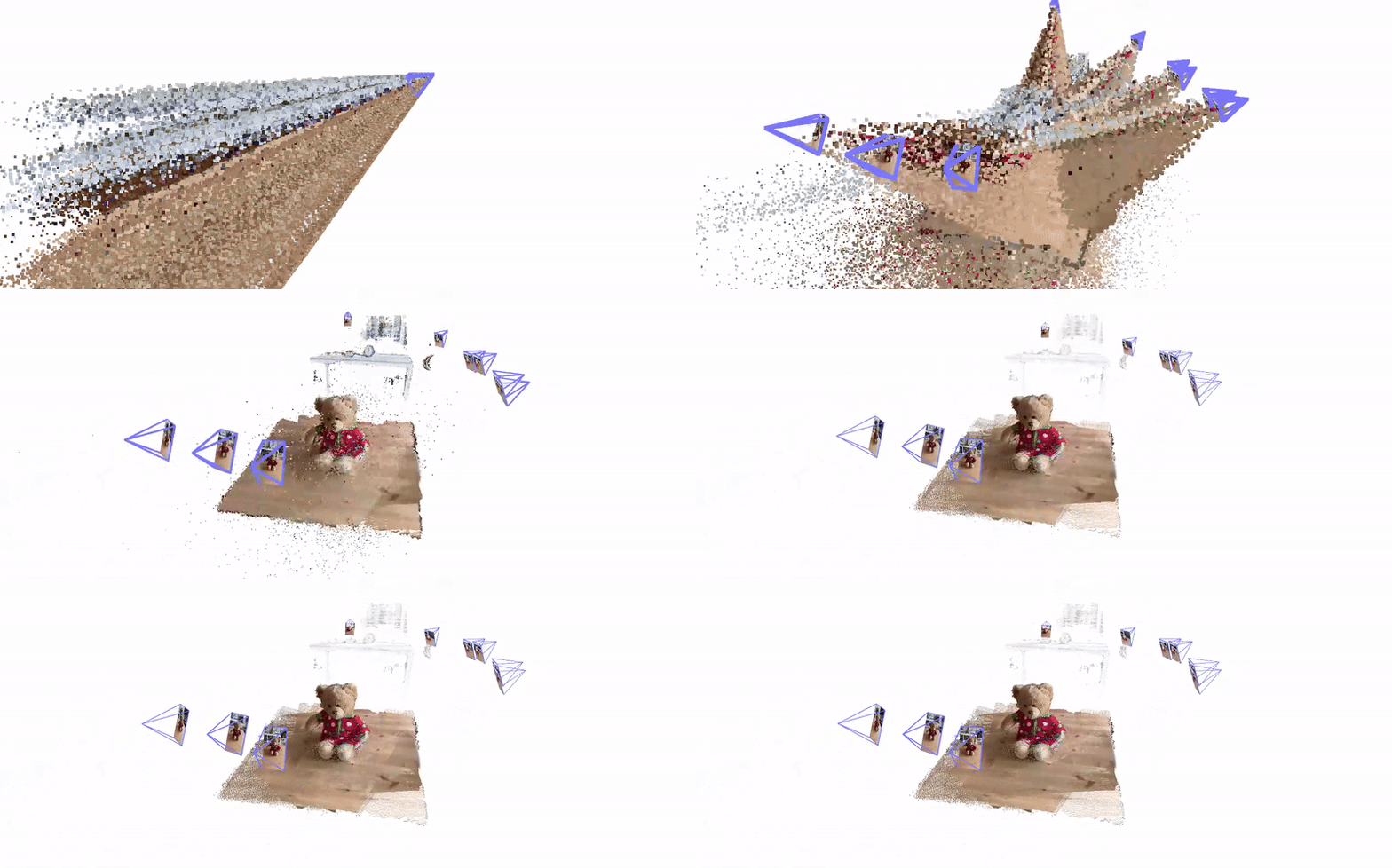
Pointmap representing images in 3D coordinates
Q. How has DUSt3R changed 3D reconstruction?
Looking back, it was truly a paradigm shift as researchers realized how easily different 3D data could be integrated into a unified framework. This significantly simplified the process of training 3D vision neural networks. Since DUSt3R’s introduction, most 3D vision researchers have adopted our approach.
Q. Why did you release DUSt3R as open-source?
In today’s research ecosystem, open sourcing plays a crucial role in accelerating the spread and advancement of technology. Since replicating and improving new technologies based solely on research papers is challenging, sharing code and models has become essential for enabling follow-up studies. DUSt3R’s open-source release quickly gained traction within the research community, leading to numerous groundbreaking projects worldwide. Based on DUSt3R, NVIDIA have developed InstantSplat, Google introduced Monst3R and Meta created Fast3R, and these are just a few examples among many other exciting projects.
Q. What are the current and future plans for DUSt3R’s follow-up research?
At NAVER LABS Europe, we’re developing multiple successors to DUSt3R. Notable examples include MASt3R, which enhances pixel alignment performance with metric information; MASt3R-SfM, which is capable of processing thousands of images and MUSt3R, which enables real-time reconstruction. These have already attracted significant attention, and there are many more projects in the works. The technology is also set to be integrated into NAVER’s services.
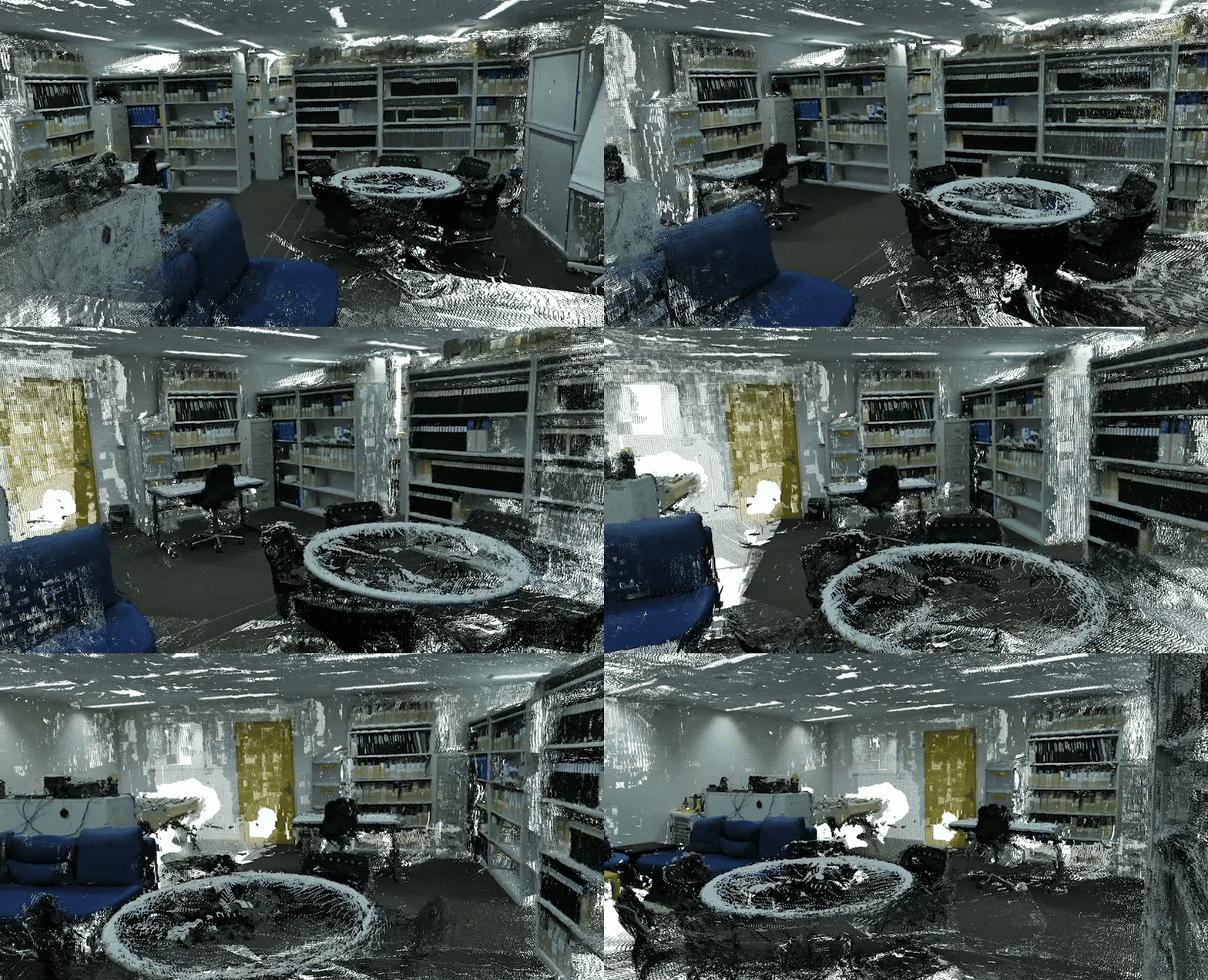
3D reconstruction from thousands of images (MASt3R-SfM)
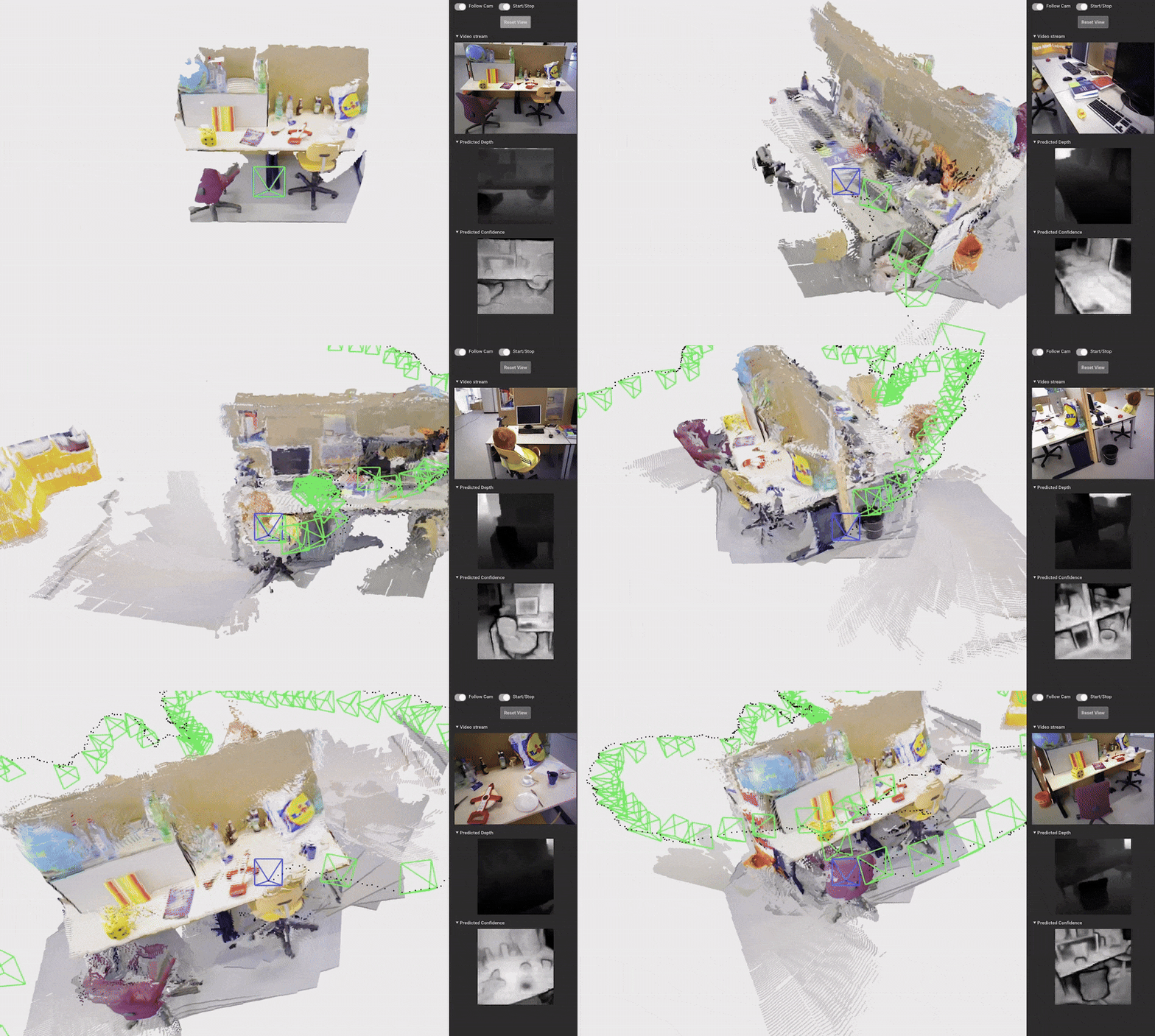
Real-time 3D reconstruction (MUSt3R)
Our ultimate goal is to integrate these technologies into a more refined and scalable 3D vision foundation model, making it possible to reconstruct entire cities with ease. We’re excited to see what innovations lie ahead, and we hope you are too.
Want to learn more about DUSt3R?
