





NAVER Receives Renewable Energy through a Third Party PPA, Leading Eco-friendly Office Infrastructure
NAVER Receives Renewable Energy through a Third Party PPA, Leading Eco-friendly Office Infrastructure
NAVER Receives Renewable Energy through a Third Party PPA, Leading Eco-friendly Office Infrastructure
- 1784 becomes the first office building in Korea using renewable energy through the PPA with KEPCO and ENlighten
- NAVER Will achieve RE100 and 2040 Carbon Negative by expanding the use of renewable energy in 1784 and IDC
2022-12-01
NAVER Corporation (CEO Choi Soo-yeon) announced that it signed a third-party Power Purchase Agreement (PPA) with Korea Electric Power Corporation (KEPCO) and ENlighten in an effort to expand the usage of renewable energy in the second office building of NAVER, 1784. NAVER is the first Korean company that sources renewable energy through a third-party PPA for its office building.
The signing of the third-party PPA is also part of NAVER’s plan to achieve RE100 and “2040 Carbon Negative.” Through this agreement, 1784 firmly established itself as a futuristic space where renewable energy is utilized on top of the existing eco-friendly infrastructure, in addition to being the first robot-friendly building in the world.
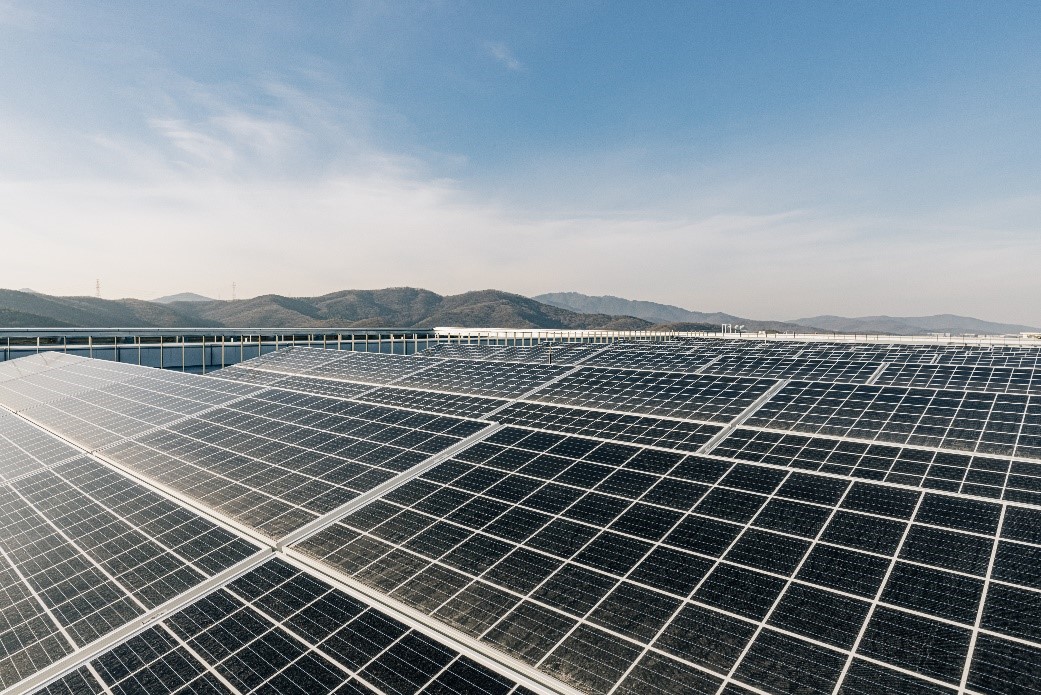
[Photo] The solar panels installed on the roof of NAVER’s 1784
NAVER expects about 15% of the annual electricity needed to run 1784 will be provided by renewable energy from Enlighten’s solar power generation. NAVER aims to continuously secure renewable energy through the third-party PPA and gradually expand the use of renewable energy not only in 1784 but also in Green Factory and the IDCs in Chuncheon and Sejong.
NAVER’s 1784 is an office building that focused greatly on applying sustainable infrastructure from the construction stage based on the operational experiences of the first office building, Green Factory. Just like Green Factory, it acquired LEED Platinum certification. Cases in point are ▲using natural energy like solar power through panels, rainwater/residential water through recycling, thermal energy, and geothermal energy; ▲adopting energy-saving infrastructures, such as double-skin, high-efficient LED lighting control, and radiant cooling. Thanks to these eco-friendly infrastructures, the building is reducing about 34% of annual energy consumption per unit area compared to other office buildings.
Lee Young-ho, CEO of ENlighten, said, “The largest IT-based resource platform in Korea is quickly and stably procuring renewable energy in accordance with the company’s needs. With the core competitiveness of ENlighten, including energy platforms and electricity market experts, we will support NAVER to successfully achieve RE100.” ENlighten is an energy IT platform company that provides various energy services, such as renewable energy power plant establishment and operation management, RE100 consulting, and power brokerage business, based on innovative IT capability and financial solutions.
Lim Dong-a, the executive officer of NAVER External Relations and ESG, said, “1784 will go beyond a tech-convergence building and lead futuristic space also in an eco-friendly industry. From now on, the adoption of renewable energy will be expanded through a third-party PPA, for example, across office buildings, IDC, and many more. By doing so, we will endeavor to establish a globally-recognized eco-friendly management system.”
[Appendix] About 1784’s eco-friendly infrastructure
1) Saving energy (e.g., using natural energy)
Based on the operational experiences of Green Factory, 1784 focused on expanding renewable energy usage and adopting high-efficiency energy systems. It ▲uses natural energy like solar power through panels, rainwater/residential water through recycling, thermal energy, and geothermal energy, and ▲adopted energy-saving infrastructures, such as double-skin, high-efficient LED lighting control, radiant cooling, reducing about 34% of annual energy consumption per unit area compared to other office buildings.
1-1) Double-skin There is one additional layer of glass to the exterior wall of 1784, making it a double-skin facade. This allows wind to flow between windows, naturally cooling the heat captured in-between the glass windows due to sunlight, which can save much energy.
1-2) Radiant cooling For the first time in Korea as a private high-rise building, 1784 applied radiant cooling to the floor air conditioning system which is also adopted in Green Factory. Pipelines are installed on the entire ceiling of the building so that cold water can flow through it. Through such a cooling system, where cool wind blows from the floor and cold air comes down from the ceiling at the same time, 1784 can save 13% of annual energy consumed compared to other general buildings.
1-3) High-efficient LED lighting control 1784 applied LED lights everywhere in the building and also adopted a dimming control system (the intensity of lighting is automatically adjusted considering the amount of sunlight coming in depending on whether louvers are opened or closed) in which the brightness of indoor lighting is automatically controlled. In addition, the building introduced smart control system where employees can adjust the lighting of individual spaces such as meeting rooms and their desk areas. Accordingly, it is expected that more than 16% of energy can be saved.
2) Establishing eco-friendly office life through multi-use/recycling infrastructure
1784 also paid close attention to building multi-use infrastructures and an environment where accurate recycling can take place as well as minimize waste. Instead of providing PLA biodegradable disposable cups in in-house cafes, the company works with an eco-friendly startup "Trash Busters" to provide multi-use cups. Accordingly, it has arranged a space on each floor where those cups can be collected, and also introduced a retrieve-wash-reuse system to actively promote disposable waste reduction. In addition, in cooperation with an eco-friendly startup "Super Bean," the building adopted the AI RECYCLING device for cans, PET bottles, and milk packs to be recycled more easily and accurately. When employees throw away recyclables they used, they can put them into the device without sorting and the device will automatically categorize materials and recycle them.