




NAVER’s AI Division Presents 66 AI Papers at Top Global Conferences in 2021, Proves Research Capabilities
NAVER’s AI Division Presents 66 AI Papers at Top Global Conferences in 2021, Proves Research Capabilities
NAVER’s AI Division Presents 66 AI Papers at Top Global Conferences in 2021, Proves Research Capabilities
- NAVER and affiliates published a total of 112 papers which were presented at top-tier global conferences, a 50% increase compared to 2020
- The Korean internet giant is securing its global AI competitiveness by strengthening and expanding its ecosystem of domestic and overseas AI research collaborations
- 40% of research results applied to NAVER’s current services to ensure that the benefits of AI are accessible to users
2021-12-27
NAVER CLOVA, NAVER’s AI division, proves its global competitiveness by submitting 66 papers at the world’s top AI conferences such as The International Conference on Acoustics, Speech, & Signal Processing (ICASSP), Interspeech, International Conference on Computer Vision (ICCV), and Empirical Methods in Natural Language Processing (EMNLP). Presenting double-digit papers on AI at top-tier conferences such as these is considered a great achievement even among global research groups.
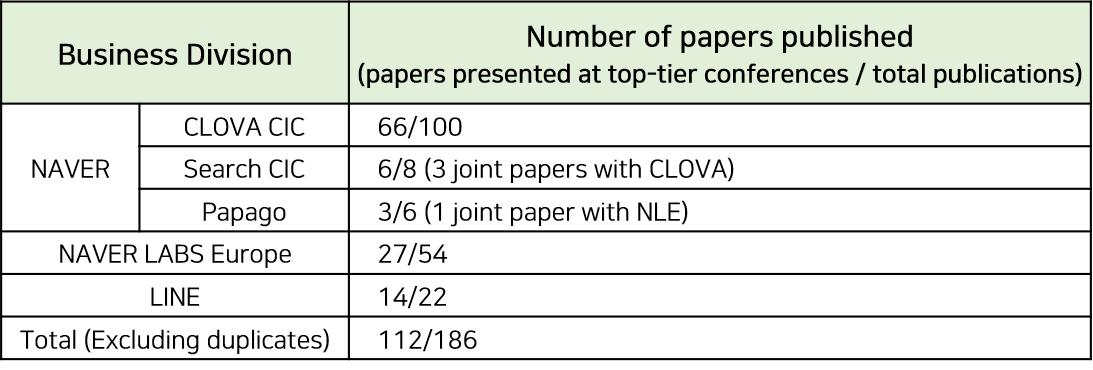
Additionally, NAVER Search CIC (company-in-company), CLOVA CIC, Papago and its affiliates—NAVER LABS Europe, and LINE—presented 112 papers at globally-renowned conferences this year. Overall, NAVER and its affiliates published a combined total of 186 papers on AI (including academic journals, workshops, and challenges) in 2021.
NAVER and Affiliates’ AI Papers Publication at International Conferences in 2021
NAVER, as a hyperscale AI pioneer in Korea, has led the discussion around Korean language AI in global academic conferences. In November 2021, NAVER presented a paper on Korea’s first hyperscale AI, HyperCLOVA, at EMNLP 2021, introducing the Korean language AI to the global stage. At NeurIPS 2021, NAVER presented KLUE (Korean Language Understanding Evaluation), which contributed to the expansion of Korean AI research resources. KLUE is the first benchmark dataset of Korean Natural Language Understanding (NLU) which was populated by 20 domestic and foreign companies and research institutes participated. It is essential to accurately evaluate the performance of Korean language models and ensure the efficacy of AI learning.
At the NeurIPS 2021 conference, NAVER's jointly organized a successful workshop, ‘ImageNet: Past, Present, and Future’, with NAVER CLOVA, NAVER LABS Europe, Google Brain and the University of Tübingen. During the workshop, Professor Olga Russakovsky—one of the founders of the ImageNet dataset—as well as 13 of the world's leading experts in the field—gave lectures. NAVER's session during the online workshop received an overwhelmingly positive response, which is unusual as more than 400 researchers from all over the world attended and actively participated in discussions.
These achievements are the result of NAVER's continuous investment in AI technology and its global R&D network, establishing a collaborative ecosystem with top domestic and overseas research institutes. "About 40% of the papers published this year resulted from NAVER outreach programs for university student internships, and about 25% were published through collaborations with international research groups," said NAVER officials.
In 2021, NAVER has established joint research centers with top universities in Korea including Seoul National University and Korea Advanced Institute of Science and Technology (KAIST) to advance its state-of-the-art capabilities through studies in the areas of hyperscale AI and hypercreative AI. At present, researchers from NAVER and universities are working closely together at these facilities, and the results have been very promising.
NAVER’s AI specialists often give lectures at universities as adjunct professors to share their field experience and expertise, contributing to the advancement of AI education. NAVER has also achieved meaningful breakthroughs through active research collaborations with various Korean universities such as Korea University, Yonsei University, Gwangju Institute of Science and Technology, Ulsan National Institute of Science and Technology and Sogang University.
In addition to its domestic efforts, NAVER is also actively expanding its AI R&D ecosystem globally. NAVER earlier this year founded an AI research center together with Hanoi University of Science and Technology (HUST) and Posts and Telecommunications Institute of Technology (PTIT) in Vietnam, and completed a total of 10 research projects. NAVER’s collaboration with HUST has yielded significant results which were presented at EMNLP 2021. Subsequently, in July this year, NAVER signed an agreement to research ‘reliable’ AI with University of Tübingen in Germany and plans to establish a cooperative research center in the first half of 2022.
In 2021, NAVER also extended its AI R&D reach to North America, recruiting global talents and strengthening its networks, while spurring research and development of leading search engine technologies. In addition, NAVER is also collaborating with world-class research groups such as those led by Professor Cho Kyung-hyun from NYU and Professor Andrew Zisserman of the University of Oxford.
“Our goal is to enable NAVER’s research and development of AI technology to solve problems and create value in users’ daily lives,” said Ha Jung-woo, head of NAVER AI LAB. “40% of our research results make up the driving force behind our AI technologies, which are applied to innovate NAVER’s product and services. We will continue to make long-term investments and forward-thinking for global AI leadership and to solve real-world problems.”
-END-