





NAVER D-Place Report 2021
NAVER D-Place Report 2021
NAVER SmartPlace: Bringing Economic Value to Offline SMEs
NAVER D-Place Report confirms the material benefits an online platform provides to offline businesses, and explores better ways for the digital expansion of offline businesses through data analysis.
The first of the series – Economic Valuation of NAVER SmartPlace – analyzes the economic value of “NAVER SmartPlace,” a free digital platform for offline SMEs to manage their information displayed on NAVER services.
‘NAVER SmartPlace,’ a free platform for offline SMEs’ digital expansion
SmartPlace is a platform for businesses to register “My Store” information on NAVER and gain exposure on NAVER Search and NAVER Maps without any additional fee. After creating a dedicated website (SmartPlace Page), offline SMEs get access to various tools for improving business efficiencies, such as NAVER Booking, Order, SmartCall, and TalkTalk (customer chat) for free. As of December 2021, the number of offline businesses using SmartPlace totaled about 2.08 million.
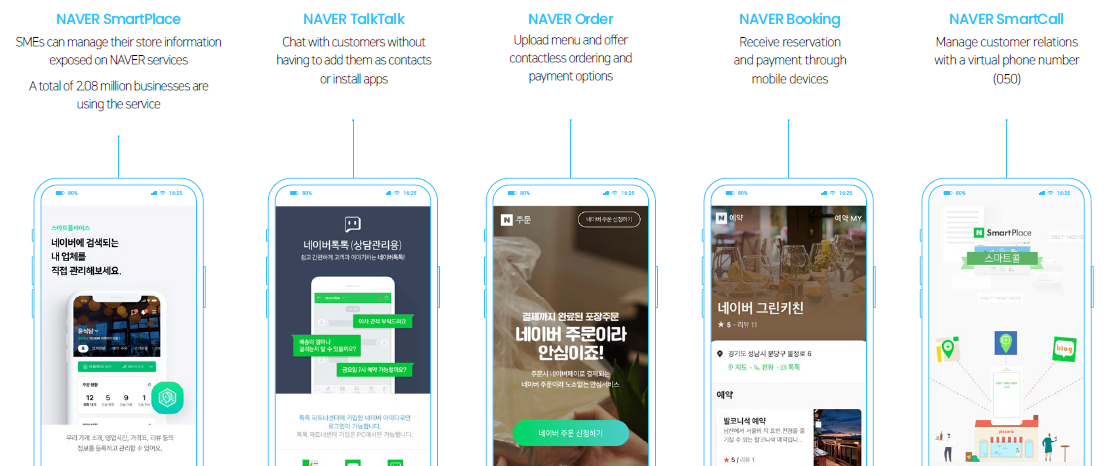
Professor Yoo Byungjoon of Seoul National University Business School and his research team conducted data analysis on the economic value NAVER SmartPlace provides to offline SMEs. The economic benefits for the businesses were measured by analyzing the effect of various SmartPlace business tools (SmartPlace Page, NAVER Reservation, SmartOrder, TalkTalk, SmartCall, local SME advertisement, etc.) on annual cost reductions and sales increases of businesses.
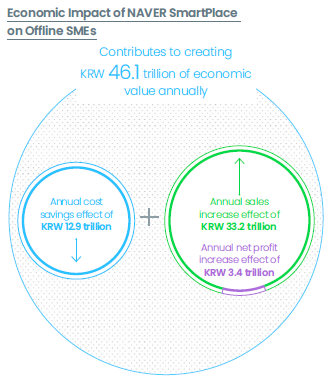
SmartPlace contributes to creating KRW 46.1 trillion in economic value each year
The analysis found that, as a free digital platform, NAVER SmartPlace contributes to creating KRW 46.1 trillion each year for offline SMEs. The findings were based on 1.69 million businesses registered as restaurants and retailers on NAVER SmartPlace, with business closure rates taken into account. As such, NAVER SmartPlace creates, on average, KRW 27.39 million worth of economic value per business.
SmartPlace saves KRW 12.9 trillion in costs for offline SMEs
SmartPlace connects offline SMEs with users through various search & discovery services, ranging from NAVER Search and Maps to SmartAround. The analysis shows that, by simply registering on SmartPlace, offline SMEs enjoy free exposure on NAVER services and save KRW 12.6 trillion in advertisement fees every year. Moreover, with SmartPlace business tools (NAVER Booking, TalkTalk, SmartCall, and Naver Order, etc.), businesses can save another KRW 219.2 billion instead of spending them on website development each year. In addition, ‘Local SME Advertisement’ enables offline SMEs to run ads at a much lower cost. Researchers found that businesses can save another KRW 72.5 billion through Local SME Advertisement compared to advertising on other global search engines. Taken together, SmartPlace enables offline SMEs to reduce costs by KRW 12.9 trillion (on average KRW 7.69 million per business) annually.
Free exposure on NAVER services increases annual sales by KRW 33.2 trillion and induces an estimated income of KRW 3.4 trillion
The research team also analyzed how much sales increased, based on the cost savings from free exposure on NAVER services, after taking ROAS (Return on Ad Spend) into account. Results show that SmartPlace brings about growth in annual sales by KRW 33.2 trillion and net profit by KRW 3.4 trillion each year for offline SMEs. On average, annual sales increased by KRW 19.7 million and net income by KRW 2.03 million. Compared to SME averages based on Statistics Korea, this effect translates to 7.9% and 5.8% increases in sales and net profit respectively.
The analysis is meaningful in that it was able to empirically confirm how a free platform like SmartPlace is contributing to creating real economic values for offline SMEs by empowering them to reach out to potential customers even at a lower cost. Professor Yoo Byungjoon, who led the project, commented: “By proactively and strategically utilizing a free digital platform like SmartPlace, offline SMEs may opt to maximize their performance and strengthen their digital connectivity and scalability.”